
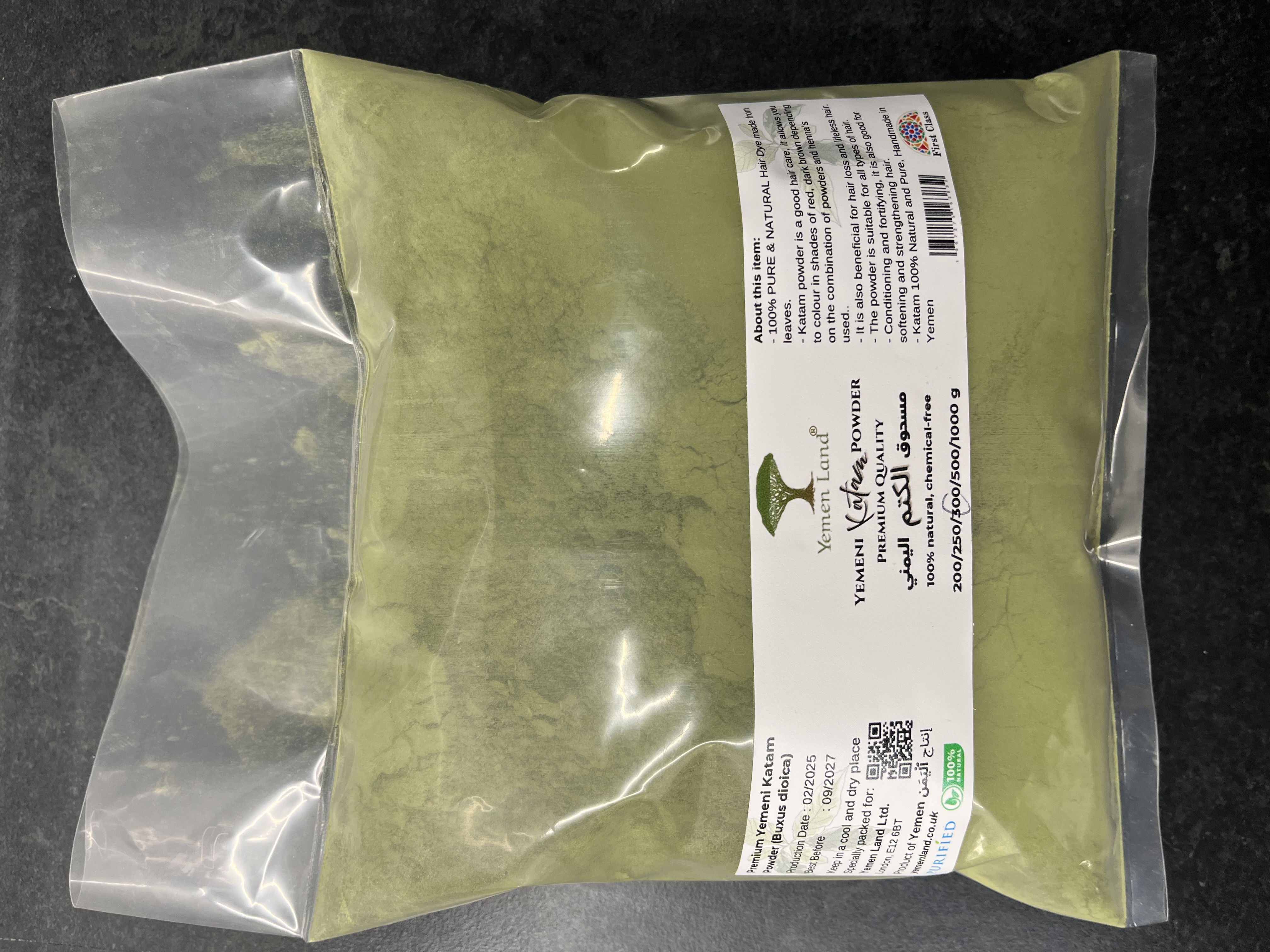
100% Organic Yemeni Katam Powder | Pure Black Hair Dye | مسحوق الكتم اليمني
Traditional Yemeni Remedy for Naturally Dark, Healthy & Shiny Hair
£7.99
Organic Raw & Pure Yemeni Katam Powder – Natural Black Hair Dye – 100% Authentic
"مسحوق الكتم اليمني العضوي 100% – خام ونقي لصبغ الشعر الأسود"
Discover the ancient beauty secret of Yemen with our Premium Yemeni Katam Powder (Buxus dioica) — a 100% natural, chemical-free hair dye known for its remarkable ability to darken hair naturally while nourishing the scalp.
100% Chemical Free - ORGANIC
Product Highlights:
100% Organic, Raw, and Pure Yemeni Katam Powder.
Botanical Name: Buxus dioica.
Natural Black Hair Dye – Achieve deep brown to black tones naturally.
No Chemicals, No Preservatives, No Additives.
Often used in combination with Henna for richer, darker results.
Sourced directly from Yemen's traditional farms.
Suitable for men and women.
Why Choose Yemeni Katam?
Katam has been used for generations in Yemen as a trusted, natural alternative to chemical dyes. Unlike synthetic products, Katam gently enhances hair colour, adds volume, strengthens strands, and leaves hair soft with a healthy shine.
Rare Yemeni Origin:
Our Yemeni black katam hails from the remote regions of Yemen, where this extraordinary natural beauty product has been cherished for generations.
Natural Coloring Agent:
Yemeni black katam is a traditional, plant-based hair and body care product known for its natural dyeing properties. It has been used for centuries to enhance hair and skin.
Deep Conditioning:
Black Katam offers deep conditioning benefits for your hair. It helps to promote hair strength, shine, and manageability while minimizing frizz and damage.
Rich in Antioxidants:
This product is rich in antioxidants, which can help protect your hair and skin from environmental stressors and free radicals, contributing to overall health and vitality.
Chemical-Free:
Yemeni Black Katam is a chemical-free and all-natural alternative to commercial hair dyes and conditioners. It doesn't contain harmful additives, making it a gentle choice for your body.
Versatile Application:
Use black katam to naturally darken your hair or to add depth to your existing hair color. It can also be used as a hair treatment mask or a natural hair conditioner.
How to Use:
Mix Katam powder with warm water to form a smooth paste
Apply evenly to clean, dry hair
Leave for 1 to 2 hours depending on desired shade
Rinse thoroughly with water
👌For a darker and richer tone, apply Katam after Henna treatment
Ideal for:
* Covering grey hair naturally
* Achieving dark brown or black shades without harsh chemicals
* Strengthening and nourishing hair
Net Weight: 250g, 1Kg
Country of Origin: Yemen
Please Note: Our Katam powder is made from natural botanical ingredients. Due to the presence of naturally occurring plant pigments, some users may notice temporary blue-toned staining on the skin, towels, sinks, or bathtubs during use. This is a normal characteristic of certain plant-based colorants and may vary slightly from one batch to another.
To minimize staining, we recommend wearing gloves and protecting fabrics and surfaces during application. Any temporary residue can generally be removed with routine cleaning.
As a natural product, slight variations in colour, texture, and pigment intensity are to be expected and reflect the authentic nature of botanical ingredients.
💚Embrace natural beauty with pure Yemeni tradition — your hair deserves the best!
Katam (Plant Used to Dye the Hair)
روى البخاري في صحيحه : عن عثمان بن عبد الله بن موهب، قال: دخلنا على أم سلمة ـ رضي الله عنها ـ فأخرجت إلينا شعرًا من شعر رسول الله، فإذا هو مخضوب بالحناء والكتم
Katam by Ibn al-Qayyim: Al-Bukhari narrated in his Sahih: From Uthman ibn Abdullah ibn Mawhib, who said: "We visited Umm Salama Radi Allaho Anha, and she brought out for us some of the hair of the Messenger of Allah صلى الله عليه وسلم. It was dyed with Henna and Katam (a plant used for dyeing hair)."
وفي السنن الأربعة : عن النبي ـ صلى الله عليه وسلم ـ أنه قال: إن أحسن ما غيرتم به الشيب الحناء والكتم
In the Sunan al-Arba'ah (the four major collections of hadith): The Prophet صلى الله عليه وسلم said: "The best thing to use for changing gray hair is Henna and Katam."
وفي الصحيحين: عن أنس رضي الله عنه، أن أبا بكر رضي الله عنه اختضب بالحناء والكتم
In the Sahihayn (Bukhari and Muslim), it is narrated from Anas Radi Allaho Anh that Abu Bakr Radi Allaho Anh dyed his hair with Henna and Katam.
وفي سنن أبي داود : عن ابن عباس ـ رضي الله عنهما ـ، قال: (مر على النبي ـ صلى الله عليه وسلم ـ رجل قد خضب بالحناء فقال: ما أحسن هذا ؟ فمر آخر قد خضب بالحناء والكتم، فقال: هذا أحسن من هذا فمر آخر قد خضب بالصفرة، فقال: هذا أحسن من هذا كله
In Sunan Abi Dawood, Ibn Abbas Radi Allaho Anh narrated that a man who had his hairs dyed with Henna passed by the Prophet Muhammad صلى الله عليه وسلم, who said: "How beautiful this is!" Then another man passed by with his hair dyed with Henna and Katam, and the Prophet صلى الله عليه وسلم said: "This is better than the first." Finally, another man passed by with his hair dyed yellow, and the Prophet صلى الله عليه وسلم said: "This is better than all of them."
Al-Ghafiqi said that Katam is a plant that grows in plains, with leaves resembling olive leaves. It grows taller than a person and bears fruit of the size of peppercorns, containing seeds. When crushed, the fruit turns black. The juice extracted from its leaves induces severe vomiting when consumed (about one Ouqiyah or 30 grams) and is beneficial for treating rabid dog bites. Al-Kindi wrote that Katam seeds, when used as eye Kohl, dissolve cataracts and cure the eyes.
Distinction Between Katam and Wasmah: Some mistakenly consider Katam to be Wasmah (indigo leaves), but this is incorrect. Wasmah is a plant with long leaves tinged with a bluish color, larger than Khilaf leaves, resembling bean leaves but bigger. Wasmah is imported from Hijaz and Yemen. Katam, however, is distinct and used differently.
Prophetic Practice of Hair Dye: In Sahih Al-Bukhari, Anas Radi Allaho Anh narrated that the Prophet Muhammad صلى الله عليه وسلم did not dye his hair. However, Imam Ahmad ibn Hanbal reconciled this by stating that others testified to the Prophet's use of hair dye, and the testimony of those who witnessed it holds precedence. Imam Ahmad, along with many other Hadith scholars, affirmed the use of dye by the Prophet صلى الله عليه وسلم, while Imam Malik denied it.
Katam is often mixed with Henna for dyeing hair, producing a darker shade that strengthens the hair. When boiled, its roots produce ink that can be used for writing. Katam is a versatile plant with significant cosmetic and medicinal applications, distinguished from indigo (Wasmah) and valued for its benefits in traditional remedies.
Clarification Regarding the Use of Katam (كَتَم) and Black Dye for Hair: In Sahih Muslim, it is narrated that the Prophet Muhammad صلى الله عليه وسلم forbade using pure black dye, as in the case of Abu Quhafah, whose head and beard were entirely white like Thaghamah (a tree with white flowers). The Prophet صلى الله عليه وسلم said: "Change this white hair, but avoid black."
The prohibition applies specifically to using pure black dye (Tasweed al-Baht~التَّسْوِيدِ الْبَحْتِ).
However, when Katam is mixed with Henna or other ingredients, the resulting color is a blend of red and black, which produces a dark brown or chestnut hue rather than jet black.
Katam differs from Wasmah (indigo leaves), which creates a deep, pure black color. This opinion is considered the stronger of the two.
To explain Sufrah (Yellow dye) فمر آخر قد خضب بالصفرة, we look into another Hadith :
وعن نافع عن ابن عمر رضي الله عنهما: (أن النبي صلى الله عليه وسلم كان يلبس النعال السبتية ويصفر لحيته بالورس والزعفران، وكان ابن عمر يفعل ذلك) رواه أبو داود و النسائي
According to a narration reported by Nafi' on the authority of Ibn Umar (may Allah be pleased with them), the Prophet Muhammad صلى الله عليه وسلم used to wear Sabatean shoes (of Yemeni origin) and dye his beard yellow using Wars (a type of plant) and saffron. Ibn Umar (may Allah be pleased with him) also followed this practice. This narration is recorded by Abu Dawood and An-Nasa’i. The key point emphasized here is that black dye should be avoided when coloring the hair. And Allah knows best.
Katam (كتم) by Ibn al-Baytaar : Abu Hanifah wrote that Katam is a mountain shrub. Its leaves are dried, ground, and mixed with henna to dye hair, producing a black color while also strengthening the hair. According to Bedouins, Katam grows in difficult, rocky terrain, hanging down like fine threads. The plant is green, with leaves resembling myrtle leaves and a yellowish hue. Harvesting it is challenging.
Al-Ghafiqi: Katam is known in Andalusia as a plant that grows in plains. Its leaves resemble those of an olive tree. The shrub grows taller than a person and bears fruit about the size of peppercorns, with seeds inside. When ripe, the fruit turns black. Oil can be extracted from its seeds and used for anointing in some Bedouin regions.
Leaves and Juice: The leaves are crushed to extract their juice. Drinking approximately one Ouqiyah (about 30 grams) induces strong vomiting and is beneficial for treating rabid dog bites.
Eye Treatment: Al-Kindi mentioned that the juice from Katam seeds, when used as an eye ointment, can dissolve cataracts and cure other eye ailments.
Other Applications: A type of Katam root, when boiled in water, produces an ink-like substance suitable for writing.
Q: Why did I notice a blue tint on my skin, towel, or bathtub?
A: Katam contains naturally occurring botanical pigments that may occasionally leave temporary blue-toned residue during application and rinsing. This is a normal characteristic of some plant-based colorants and does not affect the quality of the product.

